

The magnet test is one of the quickest ways to check if a piece of jewelry might be gold. It takes about two seconds, costs nothing, and you can do it at your kitchen table. But it’s also one of the most misunderstood tests out there.
A magnet can help you rule out obvious fakes. It cannot confirm that something is real gold. That distinction matters a lot if you’re planning to sell.
Disclaimer
The magnet test is a basic screening method only. It cannot confirm gold authenticity, determine karat purity, or detect gold plating over non magnetic base metals. Do not make buying or selling decisions based solely on a magnet test. Always seek professional evaluation from a licensed gold buyer or certified appraiser before selling gold jewelry. Results may vary based on magnet strength, jewelry composition, and testing conditions.
How the Magnet Test Works
The Simple Version
Gold is not magnetic. Neither are most gold alloys used in jewelry (10K, 14K, 18K, 24K). If you hold a magnet to gold jewelry and it sticks, the piece contains a magnetic metal like iron or steel underneath. That means it’s not solid gold.
The Science Behind It
Gold is classified as a diamagnetic metal. That means it’s weakly repelled by magnetic fields, not attracted to them. Silver, copper, and platinum behave the same way.
This is basic periodic table chemistry, and the Royal Society of Chemistry lists gold’s magnetic behavior as diamagnetic in its elemental profile.
Ferromagnetic metals like iron, nickel, and cobalt are the opposite. They’re strongly attracted to magnets. If any of these metals are hiding under a gold coating, the magnet will find them.
If your jewelry is solid gold, a magnet shouldn’t have any effect on it.
What You Need
Not just any magnet. A standard fridge magnet is too weak to give reliable results.
Use a Neodymium Magnet
These are small, powerful rare earth magnets available at hardware stores or online for a few dollars. They’re strong enough to detect magnetic base metals even through thin gold plating.
Size Matters
A magnet about the size of a coin works best for jewelry testing. Too large and it’s awkward. Too small and the pull might not be noticeable on smaller pieces.
Step by Step: How to Do It
Step 1: Clean the Piece
Wipe off any dirt, lotion, or grime. A clean surface gives clearer results.
Step 2: Place the Jewelry on a Flat Surface
Set it on a non-metallic surface like a wooden table or countertop. Don’t hold it in your hand because your fingers can interfere.
Step 3: Slowly Bring the Magnet Close
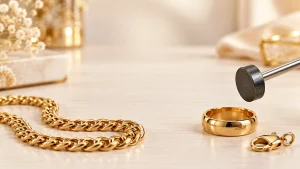
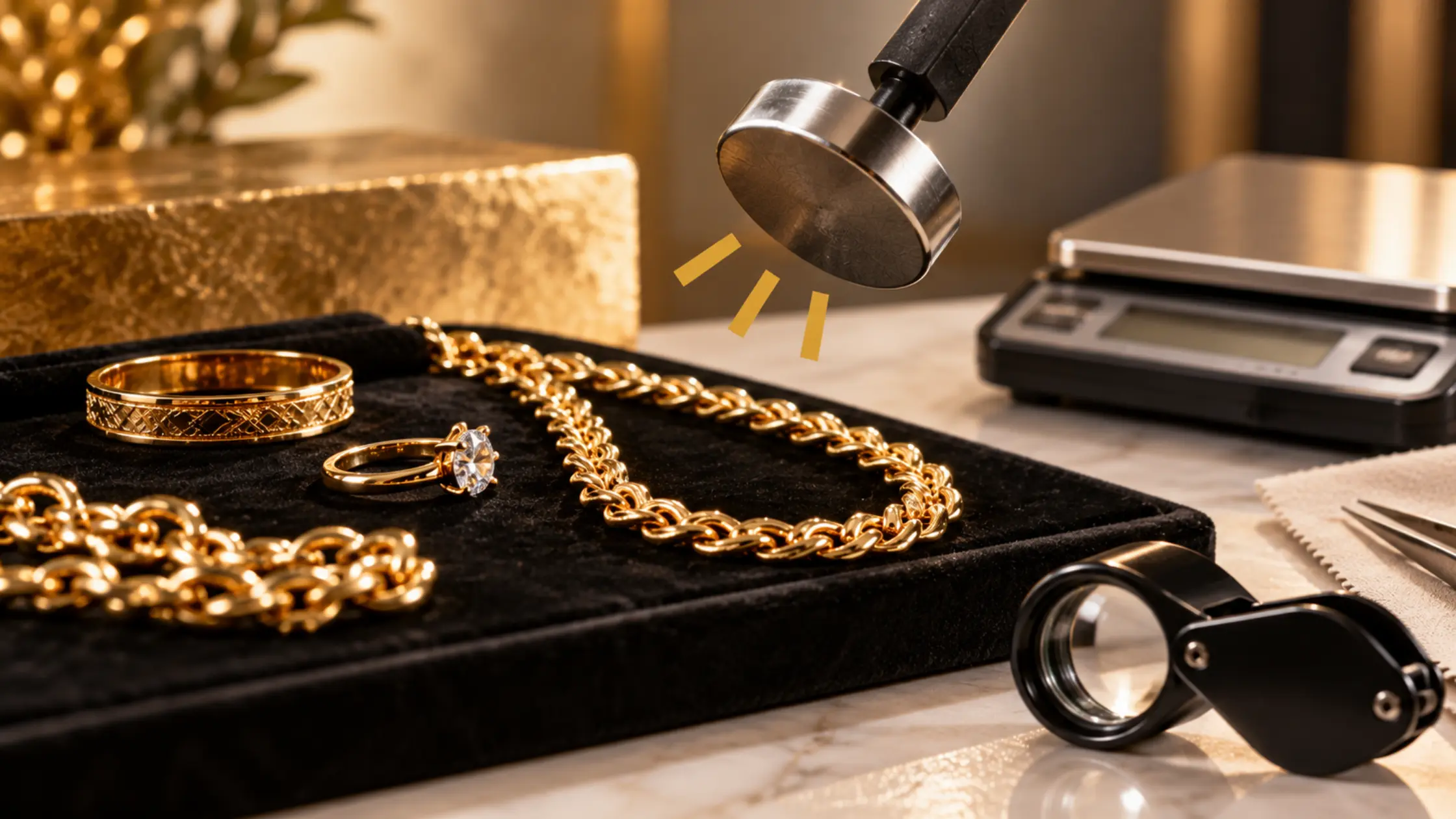
Move the neodymium magnet toward the piece slowly. Watch for any pull, movement, or attraction.
Step 4: Observe the Reaction
- Strong pull or sticks: The piece contains magnetic metal. Not solid gold.
- Slight tug: Could indicate a small magnetic component (like a steel clasp or spring) inside an otherwise gold piece.
- No reaction at all: The piece is non-magnetic. Could be gold, but not confirmed yet.
Step 5: Test the Clasp Separately
On chains and bracelets, the clasp mechanism sometimes contains a small steel spring even on solid gold pieces. Test the main body and clasp separately so a magnetic spring doesn’t make you dismiss a real gold chain.
What the Magnet Test Tells You
It Can Rule Out Obvious Fakes
If the entire piece sticks firmly to a magnet, it’s definitely not solid gold. This catches:
- Gold plated steel jewelry
- Costume jewelry with gold colored coating
- Cheap counterfeits with iron or steel cores
It’s a Fast First Screening
Before spending time on more detailed checks like stamps, weight, or professional testing, the magnet test gives you a 2 second answer on whether it’s even worth investigating further. It’s a useful first step when preparing gold jewelry before selling.
What the Magnet Test Cannot Tell You
This is the part most people get wrong. Passing the magnet test does NOT mean the piece is gold.
Many Non Gold Metals Are Also Non Magnetic
Brass, copper, aluminum, lead, and stainless steel (some grades) are all non magnetic. A brass ring with gold plating will pass the magnet test despite containing zero solid gold.
Here’s what fools the test:
| Metal | Magnetic? | Looks Like Gold? |
| Brass | No | Yes (yellowish) |
| Copper | No | Somewhat (reddish) |
| Aluminum | No | No |
| Lead | No | No |
| Stainless steel (some grades) | Weak or no | With plating, yes |
| Bronze | No | Yes (yellowish) |
A gold plated brass necklace will sail through the magnet test with no reaction whatsoever. That’s why the magnet test alone is never enough.
It Can’t Determine Karat
Even if the piece is real gold, a magnet tells you nothing about whether it’s 10K, 14K, 18K, or 24K. Karat determination requires acid testing, electronic testing, or XRF analysis. Understanding gold purity levels requires actual testing, not magnets.
It Can’t Detect Gold Fill or Vermeil
Gold filled (GF) and gold vermeil pieces have enough gold on the surface to behave like gold with a magnet. The base metal underneath (brass for filled, sterling silver for vermeil) is also non magnetic. The magnet test misses these entirely.
Why Professional Testing Is Always Better
The magnet test is a useful screening tool at home. But if you’re making a decision about selling, you need a professional evaluation.
What Professionals Use
Gold buyers have access to methods that a magnet simply can’t match:
- Acid testing: Confirms karat by chemical reaction. Quick and accurate for solid gold.
- XRF scanners: Non-destructive X-ray analysis that shows exact metal composition including plating layers.
- Electronic testers: Measure electrical conductivity to estimate karat.
These tools can distinguish between solid gold, gold plated, and gold filled in minutes. A magnet can’t do any of that. Read the full breakdown of how gold buyers test your jewelry to see what happens during a professional evaluation.
Professional Testing Is Usually Free
Most gold buyers test your jewelry at no charge as part of the appraisal process. You bring the piece in, they test and weigh it, and give you an offer. If you don’t like the number, you walk away with your jewelry. No cost, no obligation.
The FTC’s Jewelry Guides require accurate representation of gold content. Professional buyers follow these standards and use proper equipment to back up their claims. A magnet test at home doesn’t carry that level of reliability.
When You Should Skip Straight to a Professional
- The piece has no karat stamp or the stamp is unclear
- You suspect it might be gold filled rather than solid
- The piece is valuable enough that a wrong assumption could cost you money
- You’re planning to sell and need an accurate karat reading
- You have multiple pieces and want them sorted properly
For sellers in Rockford, IL, SSAJ tests every piece with professional equipment so you know exactly what you have.
Common Mistakes With the Magnet Test
Assuming no reaction means real gold. The most common mistake. Non magnetic doesn’t equal gold. Brass, copper, and many other metals pass the test too.
Using a weak magnet. Fridge magnets don’t generate enough force. Only neodymium magnets are strong enough for reliable results.
Testing only the clasp. Some clasps have steel springs. If you only test the clasp and it sticks, you might dismiss a real gold chain. Always test the main body separately.
Ignoring partial reactions. A slight tug might mean the piece has a small magnetic component but is otherwise gold. Or it could mean the plating is thin and the steel core is partially shielded. Partial reactions need professional follow up, not assumptions.
Final Thoughts
The magnet test is free, fast, and useful for catching obvious fakes. But that’s all it is. A first filter. It can’t confirm gold, can’t tell you the karat, and can’t detect quality plating. If you’re serious about knowing what your jewelry is worth, professional testing is the only reliable path.