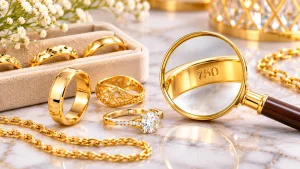


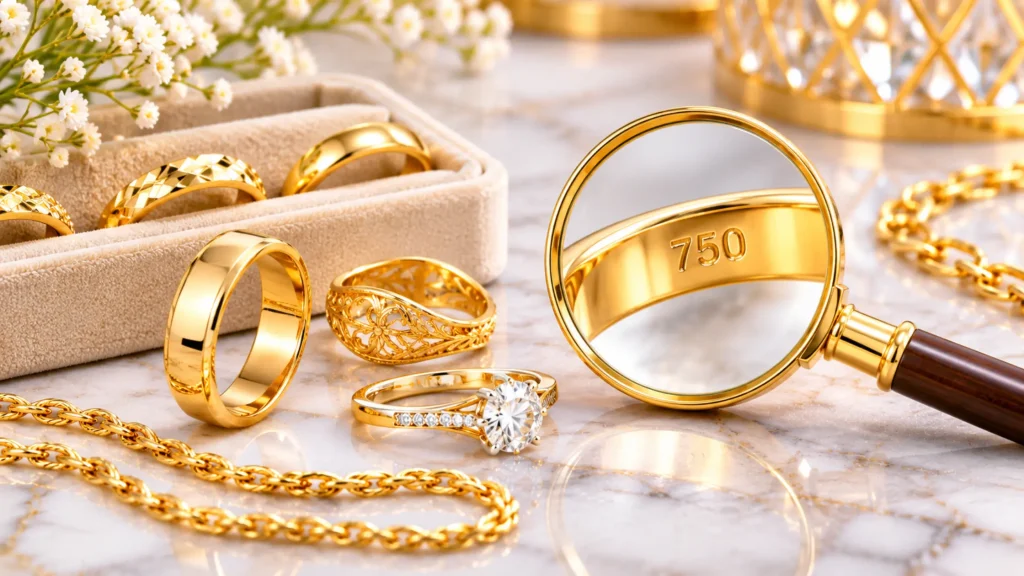
That tiny marking stamped inside your ring or scratched near a clasp? It’s not decoration. It tells you whether your jewelry is solid gold, gold plated, or something in between.
Most people glance at these stamps and have no idea what they’re reading. Here’s how to decode every common gold marking so you know exactly what you’re holding.
How the Karat System Works
The karat system measures how much pure gold is mixed into a piece of jewelry. Pure gold is 24 karats. Any purity level below that is gold blended with other metals like copper, silver, or zinc to make it harder and more wearable.
A 10K ring contains 41.7% gold. A 14K ring jumps to 58.3%. And 18K sits at 75%. The higher the karat number, the more actual gold is inside. Simple math, but it makes a real difference when you’re selling.
The FTC’s Jewelry Guides set the rules here. In the United States, nothing below 10K can legally be sold as “gold” without a qualifier. So if you see a 10K stamp, that’s the minimum threshold for solid gold jewelry in this country.
The Fineness Number System (375, 417, 585, 750, 916, 999)
Not every country uses karats. Much of Europe, the Middle East, and Asia stamps gold with a three digit fineness number instead. This number tells you parts per thousand of pure gold.
| Fineness Stamp | Karat Equivalent | Gold Percentage |
| 375 | 9K | 37.5% |
| 417 | 10K | 41.7% |
| 585 | 14K | 58.5% |
| 750 | 18K | 75.0% |
| 875 | 21K | 87.5% |
| 916 | 22K | 91.6% |
| 999 | 24K | 99.9% |
So that ring stamped 750? It’s 18K gold. The number 585 inside your chain? That’s 14K. Once you know the conversion, the system is actually more precise than karats because it gives you the exact percentage in three digits.
The Birmingham Assay Office in England has been hallmarking precious metals since 1773. They use the fineness system as part of the UK’s legal hallmarking standard. Many European countries follow similar rules under the Vienna Convention on Precious Metals.
If you’re trying to figure out whether your piece is worth selling or keeping, knowing the fineness number is half the battle.
Stamps That Mean Your Jewelry Is NOT Solid Gold
This is where people lose money. These stamps look legitimate. They use gold terminology. But they all mean your piece has a base metal core with a thin gold layer on top.
GP, GEP, and KGP
GP stands for gold plated. GEP means gold electroplated. KGP is karat gold plated. All three describe essentially the same thing: a microscopic layer of gold (typically 0.5 to 2.5 microns thick) bonded over brass, copper, or steel.
That gold layer is so thin it can wear off with regular use. And the actual gold content? Practically zero in terms of resale value. A gold buyer won’t pay anything meaningful for plated jewelry because there’s nothing to recover.
HGE (Heavy Gold Electroplate)
HGE sounds better than regular plating, and technically the gold layer is slightly thicker. But “heavy” is relative. You’re still looking at a fraction of a gram of actual gold on the entire piece. It’s not worth selling for gold content.
People find HGE stamps on costume jewelry from the 1970s and 1980s and assume they’ve found something valuable. They haven’t. If you want to know what actually holds value, solid gold is the answer.
GF (Gold Filled)
Gold filled is the best of the non solid options, but it’s still not solid gold. A GF piece has a thicker gold layer mechanically bonded to a base metal core. By FTC standards, gold filled items must contain at least 5% gold by weight.
You might also see stamps like “1/20 14K” or “1/10 12K.” These tell you exactly how much of the piece’s weight is gold. One twentieth of 14K gold is better than plating, but it’s nowhere near solid.
Some buyers will purchase gold filled items in bulk, but expect pennies compared to what solid gold pieces bring.
RGP (Rolled Gold Plate)
Rolled gold plate is similar to gold filled but with an even thinner gold layer. The gold content is minimal. Not worth a trip to a buyer for a single piece.
Other Stamps You Might Run Into
925 on Gold Colored Jewelry
A 925 stamp means sterling silver, not gold. If the piece looks gold, it’s likely gold vermeil, which is sterling silver coated with at least 2.5 microns of gold. The silver underneath has value, but this isn’t a solid gold piece.
950
This is platinum. 950 means 95% pure platinum. If you find this stamp, you’re holding a different precious metal entirely, and it’s often worth more per gram than gold.
Italian Hallmarks (Star + Number)
Italian gold frequently carries a star symbol alongside the fineness number and a manufacturer’s code. That star confirms the piece was registered with an Italian assay office. Italian 18K gold jewelry is well respected worldwide, and pieces with these markings tend to be high quality.
Country Specific Symbols
Some nations use pictorial hallmarks instead of (or alongside) numbers. The UK stamps a crown on gold items. Switzerland uses a St. Bernard dog head. France uses an eagle head for 18K gold. These assay marks confirm the piece was independently tested and certified by a government authority.
Where to Find the Stamp
Stamps are small. Sometimes you need a magnifying glass or jeweler’s loupe to spot them.
- Rings: Inside the band
- Necklaces and chains: On or near the clasp, or on a small attached tag
- Bracelets: Inside the band or by the clasp
- Earrings: On the post or back of the stud
- Pendants: On the bail (the loop connecting it to the chain) or the back
Older pieces and handmade jewelry sometimes have no stamp at all. That doesn’t automatically make them fake. It just means you’ll need professional testing to confirm what’s inside.
How Stamps Affect What You Get Paid
The stamp is literally the first thing a gold buyer checks. It tells them where to start before they even pick up a scale.
Solid gold stamps (10K through 24K, or 417 through 999) mean real value. The buyer verifies purity with testing, weighs the piece, and calculates your offer based on gold content and the current spot price. Higher karat stamps mean more gold per gram and a bigger payout.
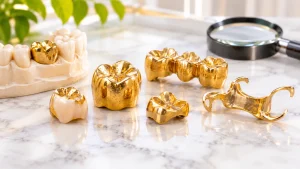
Even damaged or broken pieces with solid gold stamps are worth selling. Scrap gold gets melted down regardless of condition, so the stamp matters way more than how the piece looks.
Plated and filled stamps (GP, GF, HGE, RGP, GEP, KGP) mean little to no payout. The gold content is too small to justify processing. Separate these from your solid pieces before visiting a buyer so you don’t waste time on items that won’t bring anything.
No stamp just means extra testing. If the piece tests positive for gold, it gets priced the same as stamped gold. If it tests negative, at least you know. Either way, preparing your jewelry before selling includes checking for stamps first.
Quick Reference Chart
| Stamp | Solid Gold? | Worth Selling? |
| 10K, 14K, 18K, 22K, 24K | Yes | Yes |
| 417, 585, 750, 916, 999 | Yes | Yes |
| GP, GEP, HGE, KGP, RGP | No | No |
| GF, 1/20 14K | No (gold layer only) | Minimal value |
| 925 (gold colored) | No (silver base) | Silver value only |
| 950 | No (it’s platinum) | Yes, often more than gold |
| No stamp | Unknown | Needs testing |
Bottom Line
Five minutes learning these stamps can save you from selling gold plated brass thinking it’s the real thing. Or from tossing a 750 stamped Italian chain into a junk drawer because you didn’t know that number meant 18 karat.