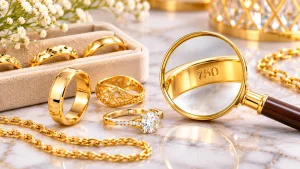


That gold necklace you bought for $30 online? Probably not solid gold. That heavy ring your grandmother left you? Might be. The problem is, both can look identical to the naked eye.
And that difference between solid gold and gold plated isn’t just about quality. It’s about whether the piece is worth $500 or $5 when you try to sell it.
Here’s how to tell what you actually have.
What “Solid Gold” Really Means
Solid gold doesn’t mean pure gold. It means the metal is gold all the way through, not just on the surface. A solid gold ring could be 10K, 14K, 18K, or 24K. The karat tells you how much of that solid metal is actually gold versus alloy.
- 24K: 99.9% pure gold. Too soft for most jewelry.
- 18K: 75% gold. Good balance of purity and durability.
- 14K: 58.3% gold. The most common in U.S. jewelry.
- 10K: 41.7% gold. The minimum karat that can legally be called “gold” in the United States.
That legal definition comes from the FTC. Their Jewelry Guides state that anything marketed as “gold” in the U.S. must be at least 10K. Anything below that can’t use the word gold in its description without a qualifier.
What “Gold Plated” Really Means
Gold plated jewelry has a base metal core (usually brass, copper, or steel) with a thin layer of gold applied to the surface. That layer is incredibly thin, often just 0.5 to 2.5 microns. For reference, a human hair is about 70 micrometres thick. The gold coating on plated jewelry is 30 to 140 times thinner than that.
The Different Types of Non Solid Gold
Not all “fake gold” is the same. There’s a hierarchy:
| Type | Gold Layer Thickness | Stamp | Resale Value |
| Gold plated | 0.5 to 2.5 microns | GP or GEP | Almost nothing |
| Gold filled | 5% of total weight in gold | GF or 1/20 14K | Very low |
| Gold vermeil | 2.5+ microns over sterling silver | Vermeil | Low |
| Solid gold | Gold all the way through | 10K, 14K, 18K, 24K | Significant |
Gold plated (GP or GEP): Thinnest layer. Wears off fastest. The gold content is so minimal that most buyers won’t even purchase it.
Gold filled (GF): Thicker than plating. The gold layer is mechanically bonded to the base metal under heat and pressure. Better quality than plated, but still not solid gold. Some buyers will purchase gold filled items, but expect very little.
Gold vermeil: A thicker gold layer (at least 2.5 microns) over sterling silver specifically. Slightly more valuable than standard plating because the base metal is silver, not brass.
5 Ways to Tell Them Apart
1. Check the Stamp
This is the fastest method. Look inside the band, near the clasp, or on the back of the piece.
- 10K, 14K, 18K, 24K = solid gold
- GP = gold plated
- GEP = gold electroplated
- GF or 1/20 = gold filled
- 925 with gold color = likely gold vermeil over sterling silver
- No stamp at all = suspect
Some older or handmade pieces won’t have stamps. And some counterfeit pieces have fake stamps. So the stamp is a starting point, not a guarantee. Learn more about spotting fake gold jewelry beyond just the stamp.
2. Look for Wear Patterns
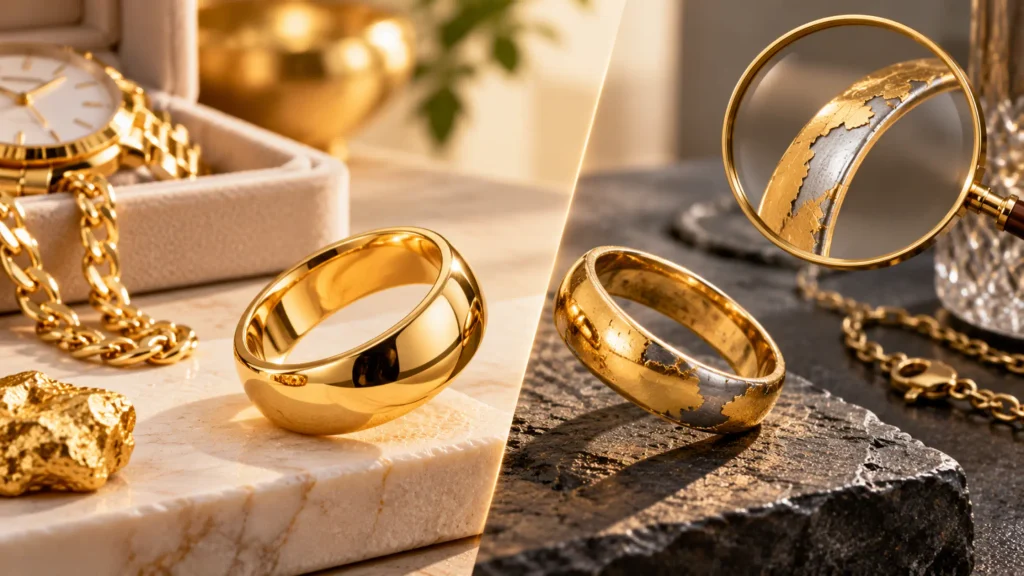
Gold plated jewelry shows its true colors over time. Literally. Look for:
- Discoloration where the piece rubs against skin or clothing (wrists, behind ears, ring edges)
- A different colored metal peeking through scratches or chips
- Green or dark marks on your skin after wearing
Solid gold doesn’t do this. It might scratch, but the metal underneath is the same gold all the way through. If you see a different color underneath the surface, it’s plated. This is also one reason gold jewelry looks different after years.
3. The Weight Test
Solid gold is dense. A solid 14K ring will feel noticeably heavier than a gold plated ring of the same size because the base metals used in plating (brass, steel) are lighter than gold.
This isn’t foolproof. Some base metals like tungsten are very heavy. But for most everyday jewelry, the weight difference between solid and plated is noticeable if you hold them side by side.
Even thin solid gold jewelry has a density that plated pieces can’t replicate at the same dimensions.
4. The Magnet Test
Gold is not magnetic. If a piece sticks to a strong magnet, the base metal underneath is steel or iron. That means it’s plated at best.
A piece that doesn’t stick could still be plated over a non magnetic base like brass or copper. So passing the magnet test doesn’t confirm solid gold. It only rules out magnetic fakes.
5. Professional Testing
When home methods aren’t enough, a gold buyer can test definitively. Acid tests, electronic testers, and XRF scanners can all determine whether a piece is solid gold and what karat it is.
Read about how gold buyers test your jewelry to understand what happens at the counter.
XRF scanners are especially useful here because they can detect plating layers that fool acid tests and electronic testers.
Why This Matters When You Sell
The difference between solid and plated isn’t academic. It’s the difference between getting paid and getting turned away.
Solid Gold
Buyers purchase solid gold in any condition. Broken, scratched, outdated, it doesn’t matter. The gold content has real value based on karat and weight. Expect offers of 60% to 90% of melt value for jewelry and higher for bullion.
Even scrap solid gold brings real money because it gets melted and refined back into pure gold.
Understanding how gold goes from raw metal to jewelry shows why the metal itself always holds value regardless of form.
Gold Plated or Filled
Most gold buyers won’t purchase gold plated items. The gold content is too small to refine profitably. Some specialty recyclers accept large batches of plated items, but the payout is pennies per piece.
Gold filled items might get you a small offer from certain buyers, but don’t expect much. The gold layer is thicker than plating but still represents a tiny fraction of the piece’s total weight.
The Retail Price Trap
Here’s what catches people off guard. You can buy a gold plated necklace for $50 and a solid 14K chain for $500. Both look similar in the store.
But at resale, the plated necklace is worth almost nothing and the solid chain might return $200 to $350 based on weight and spot price.
The depreciation gap is brutal for plated jewelry. You lose nearly 100% of the purchase price. Solid gold loses retail markup but retains metal value.
Quick Self Check Before Selling
Before visiting any buyer, run through this checklist:
- Check for karat stamp (10K, 14K, 18K, 24K)
- Look for GP, GF, or GEP markings
- Inspect wear points for discoloration or base metal showing through
- Hold a magnet to the piece
- Weigh the piece at home
- Compare weight to size (solid gold feels heavier for its size)
If you’re still unsure, a professional test takes minutes and gives you a definitive answer. Preparing before your visit with this checklist means no wasted trips and no surprises.
Final Thoughts
Solid gold and gold plated look the same on the surface. Underneath, they’re completely different. One holds real financial value. The other is costume jewelry with a gold shine. Check the stamps, look for wear, test the weight, and get a professional evaluation if you’re not sure.