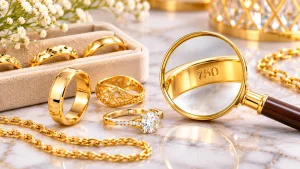


“Diamonds are forever.” You’ve heard that line a thousand times. But here’s what nobody mentions. Try selling a diamond and see how “forever” that value feels. Gold tells a very different story.
Both sit in jewelry boxes. Both cost serious money. But only one behaves like a real financial asset when it’s time to sell.
Gold Has a Price. Diamonds Have a Story.
This is the core difference most people miss.
Gold Pricing
Gold trades on global exchanges like COMEX and the LBMA. It has a live spot price that updates throughout the day. One ounce of pure gold in New York is worth the same as one ounce in London, Tokyo, or Dubai.
When you understand how gold prices are determined, you realize why gold is so much easier to buy and sell. There’s a number. It’s public. Everyone uses it.
Diamond Pricing
Diamonds have no spot price, no exchange, and no universal benchmark. A 1 carat diamond can be worth $2,000 or $15,000 depending on cut, color, clarity, and who’s selling it.
The Gemological Institute of America (GIA) provides grading standards, but grading and pricing are two different things. Two identically graded diamonds can sell for very different amounts depending on the buyer and market conditions.
What Happens When You Try to Sell Each One
This is where the difference gets real.
Selling Gold
Walk into any gold buyer with a 14K chain. They test the karat, weigh it, check the spot price, and make an offer. The whole thing takes minutes. You can verify the math yourself because the formula is simple: weight x purity percentage x spot price x the buyer’s payout rate.
Gold jewelry typically returns 60% to 90% of its melt value. Gold bullion returns 85% to 97% of the spot. Even broken or scrap gold sells fast because the buyer is paying for metal content, not appearance.
Selling a Diamond
Walk into a buyer with a 1 carat diamond ring you paid $6,000 for. The offer? Probably $1,500 to $3,000. Maybe less.
Diamonds lose 40% to 80% of their retail value the moment you buy them. The retail markup on diamonds is among the highest in the jewelry industry, often 100% to 300% over wholesale. The FTC’s Jewelry Guides require honest representation of diamond quality, but they can’t fix the markup problem.
Without a GIA grading report, expect even less. Buyers have to assume more risk on uncertified stones, so they offer less to protect themselves.
The Markup Problem
Both gold and diamonds carry retail markups. But the scale is completely different.
| Gold Jewelry | Diamond Jewelry | |
| Typical retail markup | 100% to 200% | 100% to 300% |
| Resale return (% of retail paid) | 30% to 50% | 15% to 40% |
| Resale return (% of material value) | 60% to 90% | 20% to 60% |
| Pricing transparency | High | Low |
Gold’s markup hurts, but you’re still recovering a solid percentage of the metal value at resale. Diamond’s markup is worse, AND the underlying value is subjective to begin with. Double loss.
Understanding jewelry depreciation and resale pricing shows why walking into a store expecting to get back what you paid is unrealistic for either one. But gold’s drop is much less painful than diamond’s.
Lab Grown Diamonds Changed Everything
This is the part that diamond sellers don’t love talking about.
Lab grown diamonds are chemically, physically, and optically identical to natural diamonds. The FTC confirmed this in its updated Jewelry Guides. But they cost 60% to 80% less than natural stones. And that gap keeps widening as production technology improves.
What does this mean for resale? Natural diamond values have been squeezed. Buyers are more cautious because lab grown alternatives have flooded the market. A natural diamond that felt like a “safe buy” ten years ago is now competing with a lab stone that looks identical at a fraction of the cost.
Gold doesn’t have this problem. You can’t lab grow gold. The supply is limited by what’s in the ground and what can be mined. That scarcity is part of why the World Gold Council reports that central banks keep adding to their gold reserves year after year.
Gold as Wealth vs Diamond as Luxury
Here’s the simplest way to think about it.
- Gold is money. It has been for thousands of years. Governments hold it. Banks hold it. Investors hold it. When currencies fail or markets crash, people run to gold. It’s a financial asset first and a jewelry material second.
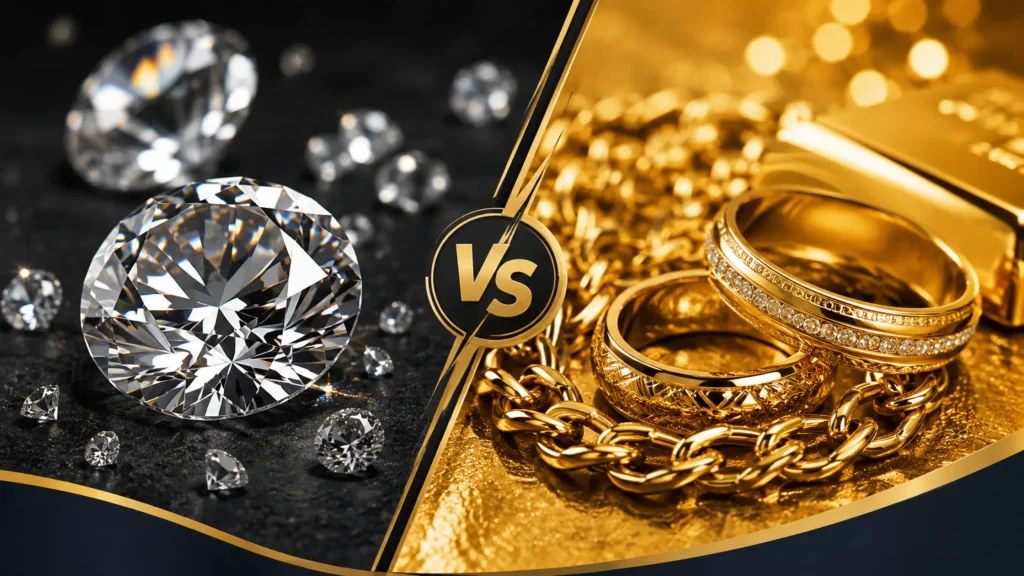
- Diamonds are luxury goods. They’re beautiful, they’re desirable, and they carry emotional significance. But they are not financial assets. No central bank holds diamond reserves. No exchange trades standardized diamond contracts. The diamond market is controlled by a handful of major companies, not by open market forces.
If you’re choosing between putting $5,000 into a gold bar or a diamond ring, and your goal is to preserve that money, gold is the obvious answer. If you’re choosing a gift that will mean something emotionally, the diamond wins on sentiment.
Both have their place. They’re just not playing the same game. If gold investing interests you, read about questions to ask before investing.
What About Jewelry That Has Both?
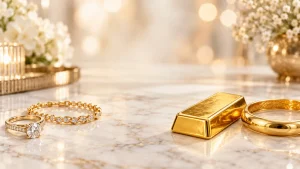
Most fine jewelry contains both gold and a diamond. An engagement ring has a gold (or platinum) setting with a diamond center stone. When you sell, each component is valued separately.
- The gold setting gets priced by karat and weight. A 14K setting weighing 5 grams has a calculable melt value. Some valuable gold items from luxury brands carry additional resale value beyond melt.
- The diamond gets evaluated based on the 4Cs and certification. A GIA certified stone with strong specs holds value better than an uncertified or lower quality stone.
If you’re selling a piece that has both, make sure the buyer evaluates the metal and stone separately. Some buyers only pay for the gold and ignore the diamond. Others can price both. Knowing what gold buyers do with your jewelry helps you understand why some buyers only focus on the metal.
Long Term Value: The Scoreboard
Gold has risen from about $300 per ounce in 2000 to over $5,000 in 2026. That’s roughly 1,500% growth in 26 years.
Standard quality diamonds (1 carat, G-H color, VS clarity) have been mostly flat over the same period. Adjusted for inflation, many have actually lost purchasing power. Only rare, high quality stones (2+ carats, D-F color, IF-VVS1 clarity) have seen meaningful appreciation.
Gold’s track record isn’t just talk. It’s data. And if you’re holding gold right now, the market is working in your favor. Check whether it’s a good time to sell at current prices.
So Which One Should You Actually Choose?
Want to protect your money? Gold. Transparent pricing, global liquidity, proven track record.
Want something beautiful for a proposal or gift? Diamond. The emotional value is real even if the financial value isn’t.
Want the best resale outcome? Gold. Every time. No contest.
Own jewelry with both? Sell to a buyer who can evaluate metal and stone separately. You’ll get more than selling to someone who only cares about one component.
Final Thoughts
Diamonds are beautiful. Gold is valuable. Those aren’t the same thing. If you’re buying for love, buy a diamond. If you’re buying for money, buy gold. And if you’re selling, know that gold will almost always give you a better return.